
3 Ways to Volunteer at a Local Football Club
A club’s biggest contribution can happen away from the pitch. Learning how to volunteer at a local football club starts with choosing a practical task that suits your time and skills. You can begin with a one-off contribution and take on a regular role if you’d like.
It can be hard to know where to start, especially if you’re new to a club or can’t commit to a full season. There are different ways to help, from lending a hand for a short time to applying for a defined role or supporting the club behind the scenes.
This guide covers three ways to get involved: helping with club activities, applying for a role and settling into it, and supporting the club’s development. You’ll get a clearer sense of what you can offer and how to take a first step in your local football community.
Table of Contents
1. Volunteer program participation
Community football clubs need help with practical tasks as well as on-pitch activities. You could welcome families, assist with registrations, set up equipment, support a team on match day or help with club communications. Choose something that suits your interests, experience and available time. You don’t need to play to contribute.
For children aged 4 to 11, MiniRoos is delivered by grassroots clubs across Australia and offers football opportunities for children of all abilities. Volunteers can help create a friendly experience around sessions by greeting families, organising equipment or assisting with simple team activities. Clubs also offer football opportunities across age groups, so volunteering can connect you with juniors, youth or adult competitions.
Match days offer a straightforward starting point. Ask the club about a specific shift, such as preparing the team area, welcoming spectators or helping direct people to the right place. A volunteer may be assigned tasks during two-hour sessions on alternate Tuesday and Thursday afternoons. Treat that as one possible arrangement, rather than a standard schedule for every club, and agree on the task and timing before you begin.
For volunteer programs and club-development resources, look at your state or territory football association’s volunteer information. It may point you towards local opportunities and practical support. In New South Wales, Football NSW recommends face-to-face recruitment for people who regularly attend a club, so a match or training session can be a natural time to introduce yourself.
If you’re deciding how to volunteer at a local football club, start by asking yourself: which task would help a session or match day run more smoothly? Tell the club what you can do, whether it’s a one-off job or a regular role. A clear first task makes it easier to get involved and see where your contribution fits.
Before accepting a role, clarify its tasks, timing and expectations. If the arrangement doesn’t suit you, say so and ask whether another task or schedule might work better. A manageable commitment makes it easier to contribute consistently.
2. Volunteer recruitment and onboarding
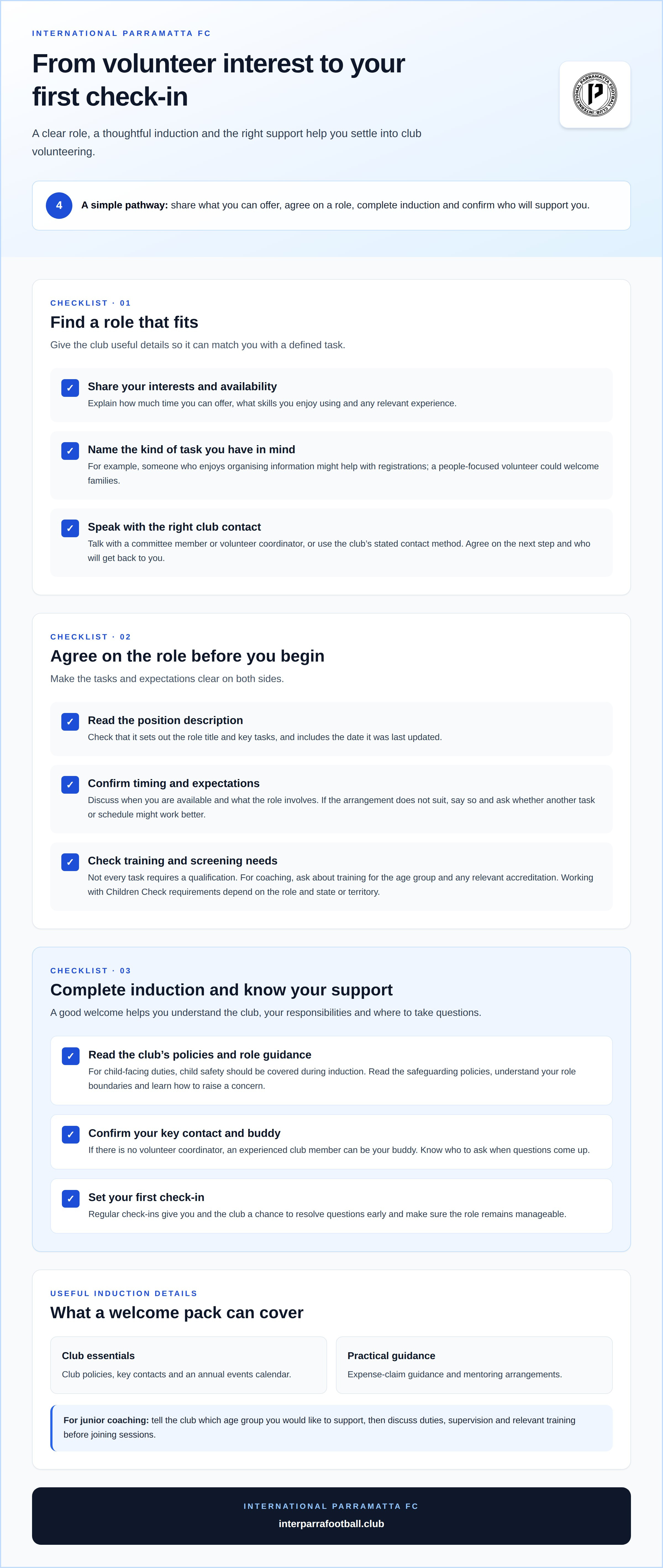
Start by explaining how much time you can offer and what skills you enjoy using. This helps a club match you with a defined task, rather than assuming you want a committee role. For example, someone who likes organising information might assist with registrations, while a people-focused volunteer could welcome families.
To express interest, speak with a committee member or volunteer coordinator, or use the club’s stated contact method. Be specific: mention the role you’re interested in, when you’re available and any relevant experience. Clubs should follow up rather than leave volunteers waiting, so agree on the next step and who will get back to you.
Not every task requires a qualification. For coaching, ask about training suited to the age group and any relevant accreditation. Working with Children Check requirements depend on the role and state or territory, so follow the club’s onboarding instructions before taking on child-facing duties.
Child safety should be covered during induction. Read the club’s safeguarding policies, understand the boundaries of your role and learn how to raise a concern. If you’re interested in helping as a junior coach or assistant coach, tell the club which age group you’d like to support and discuss duties, supervision and relevant training before joining sessions.
A clear position description should include the role title, key tasks and date last updated. A welcome pack can also set out club policies, key contacts, expense-claim guidance, mentoring arrangements and an annual events calendar. If there’s no volunteer coordinator, an experienced club member can be your buddy. Regular check-ins give everyone a chance to resolve questions early.
Use these steps to get started:
Share your interests, availability and relevant experience.
Agree on a role and read its position description.
Complete the club’s induction and any role-relevant screening.
Confirm your key contact, buddy and first check-in.
These steps make it easier to understand the role before you begin and give the club a clear way to welcome you.
3. Club development and volunteer resources
Football Australia describes volunteers as central to grassroots football and local clubs. Their work helps keep community programs running, but clubs also need to make volunteering manageable. Splitting a large role across two or three position descriptions can share the tasks and reduce the load on each volunteer.
Plan ahead rather than waiting until the club is short of help. Identify essential current and future roles, then document each role’s responsibilities, useful skills and training needs. Note possible successors so knowledge is retained when a volunteer steps away. Keep key records in a central place, including work instructions, handover notes, position descriptions and policies. This helps the next person take over without starting from scratch.
A volunteer coordinator can support recruitment, communication and recognition, as well as arrange an annual volunteer health check. Feedback can reveal whether a role is manageable or needs clearer instructions. Football NSW recommends using volunteer feedback to improve the experience and support retention. It also recommends recognising all volunteers at the club’s end-of-year celebration.
Insurance depends on the club’s policy, the volunteer’s role and the activity. Check the club’s insurance information to understand what cover applies to a particular task.
Expenses and fees are separate matters. A volunteer welcome pack can explain the process for claiming eligible expenses. Any reimbursement or charges depend on the club’s arrangements, so read the role information and expense guidance before accepting a task.
Use feedback and records to make practical improvements. If volunteers find match-day handovers unclear, for example, update the work instructions and keep them with other shared club documents. If a role feels too large, divide its duties between position descriptions. Small changes can make volunteering more accessible and help preserve club knowledge as people come and go.
Clear roles, central records and regular feedback help a club support its volunteers and prepare future leaders.
4. How to find local football clubs in Australia that need volunteers?
Australia has over 2,200 clubs where people can play football, so start close to home. Ask friends, family or colleagues whether they know a club needing help. Personal contact through people already involved is the most common way people become involved in voluntary work. A simple introduction can connect you with someone who understands the club’s current needs.
Narrow your search by suburb or nearby community. Your state or territory football association’s resources can help you find clubs in your area. Check club listings and volunteer information, then note the club’s name and preferred contact method. If you already attend matches or training, introduce yourself to a committee member or team organiser.
Make your first message clear and easy to answer. Say where you’re based, which tasks interest you and when you’re generally available. You might offer to help at a home match, assist with team administration or support a club event. Mention relevant skills, such as photography or organising information, and how you could use them.
Keep a short record of the clubs you’ve contacted, when you got in touch and any agreed follow-up. This helps you keep track without sending repeated messages. If there isn’t a suitable role right now, ask whether the club welcomes expressions of interest for future activities. A clear, friendly introduction helps volunteers understand what you can contribute.
At a match, look for a natural moment to start a conversation, such as before kick-off, during a break or after the game. Introduce yourself, say you’re interested in helping and ask who coordinates volunteers. If you’re considering a shared task, you could bring a friend or family member into the conversation.
Ready to take part in local football? Explore football opportunities and find a way to stay connected with the game.
Football clubs should identify vital current and future roles, the responsibilities and skills required, possible successors, and any training or support a new volunteer may need. Football Australia’s National Volunteer Focus Group focused on enhancing volunteer engagement and providing resources for grassroots community clubs in 2024.
International Parramatta FC: Seasonal Football Team Registration
International Parramatta FC offers Seasonal Football Team Registration for people who want to join a team and play local football. Playing and volunteering are different ways to connect with a club. If you’re keen to get on the pitch, registration is a practical next step. The club also offers Summer Soccer and Holiday Clinics.
If you’re exploring football for a child or adult, consider what suits their interests: joining a seasonal team, taking part in Summer Soccer or attending a Holiday Clinic. Club Shop Merchandise is also available for supporters and players.
For questions about getting involved with football at International Parramatta FC, please contact International Parramatta FC.
Take your next step into local football
If you’re still considering how to volunteer at a local football club, choose one achievable step: start a conversation, offer a skill or attend a club activity. That first move can help you find out whether you’d enjoy contributing behind the scenes, joining a team or spending more time around the game.
If playing is your next step, International Parramatta FC offers Seasonal Football Team Registration, Summer Soccer and Holiday Clinics. These are ways to take part in football, not volunteer roles, so choose the option that best suits how you’d like to connect with the club.
Whether you’re ready to play or still exploring ways to contribute, keep the next step simple. Explore football opportunities with International Parramatta FC, and find a welcoming way to stay involved in the game.



Comments